 Skip to main content Skip to footer
Have you ever brought vacuum-packed cooked food home from a trip only to find the package swollen? That usually means the seal has failed and the food has spoiled. Why does this happen? The answer lies in the different vacuum-packing methods and, equally important, the quality of the bags used.
Yes, vacuum bags can be used for cooked food, and this is a common way to keep it fresh. It helps reduce food waste while preserving quality and flavor. However, the effectiveness of vacuum preservation depends on the packing method, how the food is handled, and the storage conditions.
Below, I’ll explain in detail how vacuum sealing affects cooked food, the correct way to vacuum-seal it, the benefits it brings, and how to choose the right packaging. Whether you’re preparing meals at home or packaging cooked food for a restaurant, catering company, or ready-to-eat food brand, I hope these insights prove useful.
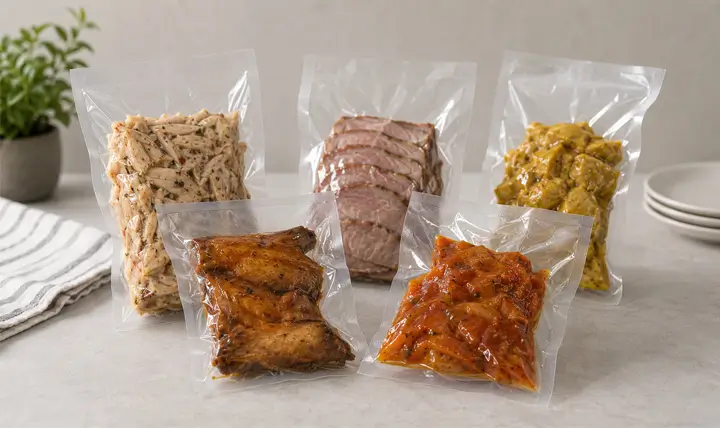
Why Vacuum-Seal Food?
In everyday life, many foods are stored using vacuum sealing. Walk through the meat section of a supermarket and you’ll see products packed in vacuum bags, thermoformed films, or shrink bags. These materials help extend shelf life, maintain quality and taste, and let customers clearly see the fresh appearance of the product.
Vacuum packaging works by removing air from the bag to create a low-oxygen environment. This slows down spoilage, reduces package volume so that refrigerator or shelf space is used more efficiently, and makes the packages easier to stack, store, and find.
Compare a piece of red meat placed directly in the refrigerator with one that has been vacuum-sealed. The unpackaged meat must be cooked quickly—otherwise it may spoil or lose its fresh taste within a few days. Vacuum-packed meat, on the other hand, can stay good for several extra days and still taste fresh when you open it. You can even use the vacuum bag for sous-vide cooking to enjoy a more refined cooking method.
Important Points When Vacuum-Sealing Cooked Food
Simply placing cooked food in a vacuum bag and removing the air is not enough. Vacuum sealing only creates an oxygen-free environment that inhibits bacterial growth. The actual preservation result still depends on storage conditions, bag quality, and how the food is prepared before packing.
For home use, a simple vacuum seal followed by storage at room temperature is not sufficient. The food should be kept at 0–4 °C (refrigerator temperature) to achieve a longer shelf life of about 7–10 days. Once removed from cold storage, it can still spoil relatively quickly. Bag quality is also critical.
In industrial settings, cooked food is usually sterilized first and then vacuum-sealed. This combination can allow the product to last 6–12 months at room temperature. Proper use of cold storage can extend the shelf life even further, giving commercial businesses a more convenient sales window.
Never seal food while it is still warm. Cooked food must be fully cooled before it goes into the bag. Sealing hot food traps steam inside; when the steam condenses, it creates moisture that weakens the seal and encourages bacterial growth.
Cooked food should be cooled as quickly as possible through the “danger zone” of 4–60 °C (40–140 °F), the temperature range in which bacteria multiply most rapidly. Use proper equipment and techniques so the food does not cool slowly and lose shelf-life potential.
When done correctly, vacuum sealing is a safe and effective way to store cooked food in the refrigerator or freezer. It does not replace refrigeration, but it is a strong complement to it.
How to Vacuum-Seal Cooked Food Safely
Vacuum packaging itself is not a sterilization process. It only reduces oxygen and slows the growth of aerobic bacteria. Anaerobic bacteria (especially Clostridium botulinum) can actually thrive in an oxygen-free environment. Therefore, vacuum sealing must always be combined with thorough cooling, low-temperature storage (refrigeration or freezing), or industrial-level sterilization.
First, the cooked food must be completely cooled to room temperature or lower. Never seal hot or warm food. Hot food stays longer in the danger zone (approximately 4–60 °C), which promotes bacterial growth. Cool the food rapidly using ice-water baths, by cutting it into smaller portions, or with professional rapid-cooling equipment.
Before sealing, work in a clean, sanitized area. Use tongs or spoons rather than your hands whenever possible, and choose food-grade vacuum bags.

After vacuuming and heat-sealing, check that the seal is intact (no leaks or damage). Immediately refrigerate (0–4 °C) or freeze (−18 °C or below). Vacuum-packed cooked food should never be stored at room temperature. In the refrigerator, it is generally best eaten within a few days to about 1–2 weeks, depending on the freshness and hygiene of the original food. Freezing allows longer storage (weeks to months), though quality will gradually decline.
Label every sealed bag with the contents and date. Labels are especially important for vacuum packs because the compressed contents can look similar, making different foods hard to distinguish.
How Long Does Vacuum-Packed Cooked Food Last?
Shelf life depends heavily on when the food is vacuum-sealed. If it is sealed immediately after cooking and then refrigerated, it can typically last 5–7 days. If the food has already been sitting out for some time—even if made the same day—microorganisms may already be present, so the vacuum-packed product should be eaten within 1–2 days.
Vacuum sealing removes oxygen and inhibits aerobic bacteria, but anaerobic bacteria such as Clostridium botulinum can become more active in the absence of oxygen. That is why low-temperature refrigeration is essential: cold temperatures greatly slow the growth of all microorganisms.
Pre-packaged supermarket products achieve longer shelf lives through a combination of vacuum sealing and high-temperature sterilization. The downside is that texture and flavor can suffer—meat may become dry or develop a jelly-like consistency.
To better preserve flavor, some companies lightly sterilize or braise the food and then vacuum-pack it right away. Stored at 0–4 °C, these products can last up to 6 months. Others use nitrogen flushing (“fresh-lock” packaging). These products require continuous cold-chain transport and sales at 0–4 °C and usually have a shelf life of about one week.
Choosing the Right Vacuum Bags for Cooked Food
Not all vacuum bags are the same, and the requirements for cooked food differ from those for raw ingredients:
Material and barrier properties: Multi-layer nylon/PE (PA/PE) co-extruded bags offer better puncture resistance and superior oxygen/moisture barriers than basic single-layer polyethylene bags. This is especially important for sauces, bones, or any items with sharp edges.
Thickness (mil): 3 mil is the standard for everyday refrigeration and freezing. Thicker 4–5 mil bags are better suited for long-term freezing or commercial processing.

Chamber vs. external sealers: External (edge) sealers work well with smooth bags and are common in home kitchens. Chamber vacuum sealers can handle liquids and irregular shapes and are the standard for commercial kitchens and food production.
Boilable / retortable bags: If the cooked food will be reheated directly in the bag—whether in boiling water, a steamer, or a microwave—the bag must be rated for that temperature range. Ordinary freezer vacuum bags are not necessarily suitable for boiling or high-pressure sterilization.
Printed / branded bags: For ready-to-eat food brands, printable stand-up pouches or three-side-seal bags combine the shelf-life benefits of vacuum sealing with retail branding.
Looking for vacuum bags specifically designed for cooked or ready-to-eat food—boilable, freezable, or custom-printed for retail? Talk with the experts at NK Packaging to find the material, barrier properties, and thickness that match your product and process.
As a trusted vacuum bag supplier, NK Packaging serves meat, seafood, cheese, frozen, and prepared-food brands:
Custom structure options — multiple constructions available (PA/PE, PET/PE, PA/EVOH/PE, PET/AL/PE) to meet your shelf-life goals and improve product quality.
OEM/ODM with low minimum order quantities — flexible procurement for new SKUs or shelf-life trials (special developments may require a higher MOQ).
End-to-end support — material recommendations, structural design, printing, and export documentation handled in one streamlined process.
Request a free quote or samples so you can select the right bag structure for your product and process.


