 Skip to main content Skip to footer
Introduction
In traditional flexible packaging, brands are often forced to make tough compromises among three core demands: achieving high barrier performance on par with aluminum foil to extend shelf life, requiring high transparency to showcase the product and attract consumers, and demanding a non-metallized structure to pass in-line factory metal detection smoothly.
High transparency and great shelf appeal aren’t always enough, while playing it safe with aluminum foil isn’t always necessary. Traditional aluminum foil (Alu Foil) offers unrivaled barrier performance, but it is opaque and non-microwavable. Standard VMPET is inexpensive, but it remains opaque and offers limited barrier properties.
With the rapid growth of ready-to-eat meals, self-heating foods, and pet food markets—coupled with global environmental trends toward “demetallization” and “mono-material recyclability”—clear high-barrier packaging delivers equivalent protection while providing excellent product visibility, reducing environmental impact, and driving economic benefits.
Next, we will take a deep dive into the microscopic physical structures to compare the fundamental differences between aluminum foil and clear high-barrier films across shelf-life protection, shelf appeal, processing technology, and full-lifecycle costs—helping you make precise material choices to achieve true cost efficiency and hassle-free production lines.
Microstructural Comparison: Clear Barrier Films vs. Aluminum Foil
EVOH Barrier Films
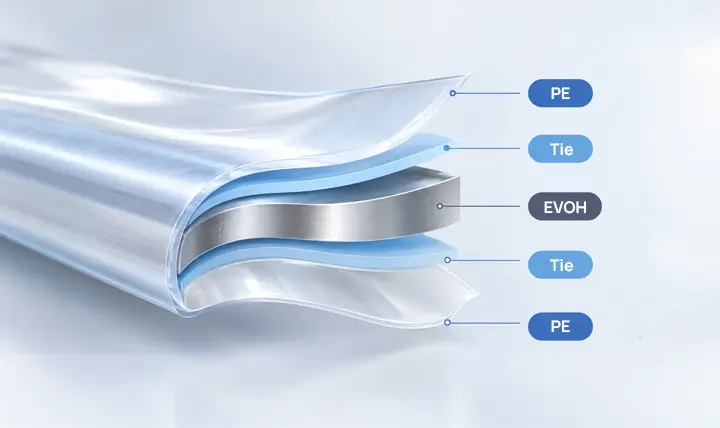
EVOH (Ethylene Vinyl Alcohol) is a highly crystalline, highly polar resin. Its tightly packed molecular structure provides exceptional resistance to the transmission of non-polar oxygen (O₂), making it an excellent oxygen barrier material.
However, EVOH is highly sensitive to moisture. When exposed to water, its oxygen barrier performance can decrease dramatically, so it needs to be protected within a multilayer structure. It is typically incorporated into 5-, 7-, or even 9-layer coextruded films, such as PE/Tie/EVOH/Tie/PE, with PE layers on both sides helping protect the EVOH layer from moisture.
The result is a combination of excellent oxygen barrier performance and good processability. EVOH-based films can be processed using conventional packaging equipment and heat-sealed like other plastic films.
Clear Metallization (AlOx/SiOx)
Clear AlOx/SiOx coating is a form of Physical Vapor Deposition (PVD). Under vacuum conditions, aluminum oxide (AlOx) or silicon oxide (SiOx) is deposited onto a PET or BOPP substrate, forming an ultra-thin, dense glass-like or ceramic-like inorganic layer.
The typical coating thickness is only a few tens of nanometers. This ultra-thin inorganic layer acts as a clear barrier, effectively blocking the pathways for oxygen and water vapor transmission.
Dual protection against oxygen and moisture. Compared with EVOH, AlOx/SiOx coatings can provide significantly stronger moisture barrier performance while maintaining excellent oxygen barrier properties.

Clear High-Barrier Films vs. Aluminum Foil
| Performance Metric | Pure Aluminum Foil (AL, 7µm) | EVOH (Standard Grade, 32mol%, 15µm) |
| Oxygen Barrier (OTR) | ≈ 0 | 0.1 – 0.5 cm³/m²·24h |
| Moisture Barrier (WVTR) | ≈ 0 | 2.0 – 4.0 g/m²·24h |
| Flex Crack Resistance | Very Poor (OTR can surge 100x after flexing) | Excellent (Virtually no barrier loss after flexing) |
| High-Humidity Resistance | Excellent (Unaffected by humidity) | Very Poor (Oxygen barrier plummets in high humidity) |
| Microwave / Metal Detection | Strictly Prohibited | Fully Compatible |
| Transparency | Opaque | High Clarity |
Why Everyone Wants to Use Clear High-Barrier Films
In reality, aluminum foil is a fantastic material, but it has one major drawback: you can’t see the product inside. Today’s consumers lean heavily toward packaging that allows them to inspect the contents directly, which often drives higher sales.
Clear high-barrier films allow consumers to clearly view the actual product condition (such as color, shape, and portion size). This significantly boosts shelf appeal and consumer purchase intent, making it ideal for fresh produce, snacks, and premium foods with high visual presentation demands.
Although the initial material cost of clear high-barrier films may be slightly higher, they can significantly reduce product damage rates caused by packaging failure. Moreover, by boosting sales and visual premium, they yield a higher overall return on investment (ROI).
So, can you completely replace aluminum foil with clear high-barrier films? The answer is yes, but certain conditions must be met. Clear high-barrier films rely primarily on materials like EVOH and PVDC to achieve barrier properties. While their performance is indeed impressive, a gap still remains compared to aluminum foil.

Here are some scenarios where they are suitable:
- Lower shelf-life requirements: Products intended to be consumed within 3 months.
- Fast-moving retail channels: High-turnover channels such as supermarkets and convenience stores.
- High visual display demands: Products where consumers need to inspect color and texture.
- Good intrinsic product stability: Low fat content, low susceptibility to oxidation, and appropriate water activity.
- Combined with other preservation methods: Such as nitrogen flushing, refrigeration, or light-protected retail environments.
On the other hand, if your product requires a shelf life of over 12 months, or is exceptionally sensitive to oxygen and light, we recommend sticking with aluminum foil or adopting a combined aluminum foil + clear window packaging solution.
Common High-Barrier Packaging Issues
1. Why Does Aluminum Foil Fail After Long-Distance Transport?
Nut or coffee pouches made with a PET/AL/PE structure pass OTR (Oxygen Transmission Rate) testing with flying colors before leaving the factory. However, after long-distance transport, customers report widespread air leakage, with products showing signs of oxidation and rancidity.
Microscopic examination reveals that the originally intact aluminum foil layer is covered with tiny flex cracks and pinholes—a classic case of aluminum foil flex cracking.
7 µm aluminum foil is indeed extremely delicate. Tension during printing and dry lamination, or repeated passing over guide rollers during pouch making, can create microscopic pinholes invisible to the naked eye. Under the continuous vibration, folding, and flexing of long-distance transport, these minor defects expand, causing microscopic fractures in the metallic barrier layer and ultimately leading to total failure of the barrier system.

The Trade-off Between Thickness and Cost
Increasing aluminum foil thickness usually translates to higher raw material costs, but it also significantly reduces the risk of pinholes and mechanical damage.
Take pinhole control as an example: 7 µm aluminum foil typically exhibits a pinhole density of ≤50/m², whereas 9 µm foil drops to ≤15/m².
Therefore, for products with strict shelf-life requirements—especially oxygen-sensitive items like coffee and nuts—rather than blindly chasing lower material costs, a safer approach is to upgrade the foil thickness to 9 µm, securing greater transport reliability and a larger barrier safety margin.
Adding a “Buffer” Layer via Structural Design
Beyond increasing foil thickness, selecting the right adjacent materials is equally critical.
The pure aluminum foil layer should not be directly paired with overly rigid films in an ill-designed structure. Consider incorporating BOPA (Biaxially Oriented Polyamide/Nylon) adjacent to the aluminum foil layer, for example:
PET / AL / BOPA / CPP
BOPA offers excellent flexibility, puncture resistance, and mechanical strength. It provides structural support when the aluminum foil is subjected to bending, impact, or flexing—acting as a protective buffer for the delicate foil.
2. Why Does EVOH Suddenly Lose Oxygen Barrier Performance in High-Humidity Environments?
Clear marinated meat packaging using EVOH co-extruded film can achieve up to a 6-month shelf life under dry winter conditions.
However, when the same batch of products is shipped to regions during the rainy plum blossom season, the meat products turn sour and discolor in less than two months.
The issue isn’t necessarily EVOH itself, but rather the change in environmental humidity.
Hydroxyl groups in EVOH molecules form strong intermolecular hydrogen bonds, creating an outstanding oxygen barrier. At the same time, however, EVOH is highly hygroscopic.
When relative humidity (RH) rises above 75%, absorbed moisture enters the EVOH polymer, weakening hydrogen bonds between molecules and increasing free volume between polymer chains. As a result, oxygen permeates much more easily, causing a significant drop in EVOH’s oxygen barrier performance.
For instance, at 0% RH, EVOH’s OTR can reach as low as 0.1; at 85% RH, however, OTR may spike to 5.0 or higher.
In other words, a barrier layer that performs exceptionally well in dry conditions may fail to maintain its target barrier performance in high-humidity environments.
EVOH Should Not Be Left “Exposed” at Outer Structural Layers
Therefore, during blown film or cast co-extrusion, EVOH should never be directly exposed as the outermost or innermost layer.
A more sensible design adopts a structure like:
PP / Tie / EVOH / Tie / PP
—a symmetrical multilayer structure.
PP or PE layers on both sides provide superior moisture protection, encapsulating the EVOH barrier layer within the structure. This creates a relatively stable, low-humidity micro-environment, helping EVOH maintain consistent oxygen barrier performance in real-world applications.
Ethylene Content in EVOH Must Also Be Considered
With EVOH, higher oxygen barrier performance isn’t always strictly better—its behavior is tightly linked to ethylene content and the application environment.
Generally speaking, lower ethylene content yields higher oxygen barrier performance in dry conditions, but increases moisture sensitivity. Higher ethylene content (e.g., 44 mol%) slightly reduces oxygen barrier performance, but significantly enhances moisture resistance, flexibility, and processing adaptability.
Therefore, for high-temperature, high-humidity, or retort applications, you shouldn’t rely solely on theoretical oxygen barrier metrics. Instead, select specialized grades with superior moisture and heat resistance tailored to actual processing conditions, temperature, and humidity.
If you are currently facing food packaging selection challenges, we recommend clarifying the following requirements before reaching out to packaging suppliers or finalizing procurement plans:
- What is the product being packed?
- Is vacuum sealing required?
- Is high-temperature sterilization needed?
- What is the storage condition (ambient, refrigerated, or frozen)?
- What is the target shelf life?
- What are the pouch type and dimension requirements?
- What is the estimated order quantity?
The more complete this information, the easier it is to pinpoint the exact packaging solution, reducing the cost of repeated sampling, revisions, and back-and-forth communication down the line.
If you are looking for a reliable flexible packaging supplier, NK Packing can provide tailored flexible packaging solutions for food enterprises based on product characteristics, sterilization methods, storage conditions, pouch types, dimensions, and order volumes.
Conclusion
The absolute barrier performance of clear high-barrier films may never fully rival flawless aluminum foil, but they possess a crucial advantage foil lacks: excellent flexibility with zero risk of flex cracking.
There is no single “universal” material in packaging. True competitive advantage comes from selecting the material best suited to your specific application and processing conditions. Only by fully understanding the limitations of each material—and leveraging smart structural design, layer combinations, and tension control—can you maximize strengths, mitigate weaknesses, and unlock optimal performance. That is the key to achieving outstanding packaging performance and establishing a genuine competitive edge.


