 Skip to main content Skip to footer
When you’re walking through the supermarket, you’ve probably noticed how certain packages “stand” firmly on the shelf — bags of snacks, pouches of juice, packs of laundry detergent, and more. They don’t need any support to stay upright, which saves shelf space and makes them stand out even more. This type of packaging that can “stand up” on its own is called a stand-up pouch, also known as a doypack.
Stand-up pouches are used worldwide by businesses and individuals for all kinds of purposes. With excellent shelf display, strong product protection, lower material use than rigid containers, and outstanding convenience for consumers, they’ve become one of the most widely used forms of flexible packaging.
This guide goes beyond the basics — it also covers structure, materials, barrier performance, functional features, the current state of sustainability, printing and production, a decision-making framework, and practical selection criteria, so you can confidently choose the right stand-up pouch.
What Is a Stand-Up Pouch?
A stand-up pouch is a flexible package with a horizontal support structure at its base, allowing it to stand upright on its own — whether open or sealed — without leaning on anything. Its bottom is designed with side gussets that expand once the pouch is filled, letting it stand upright on the shelf without any external support.
Compared to glass jars, metal cans, or rigid plastic, stand-up pouches use less material, which reduces shipping volume and weight — and, when designed well, can lower the overall carbon footprint.
Bottom Construction
The real secret to a stand-up pouch lies in its bottom construction, which determines stability, weight capacity, and tooling requirements.
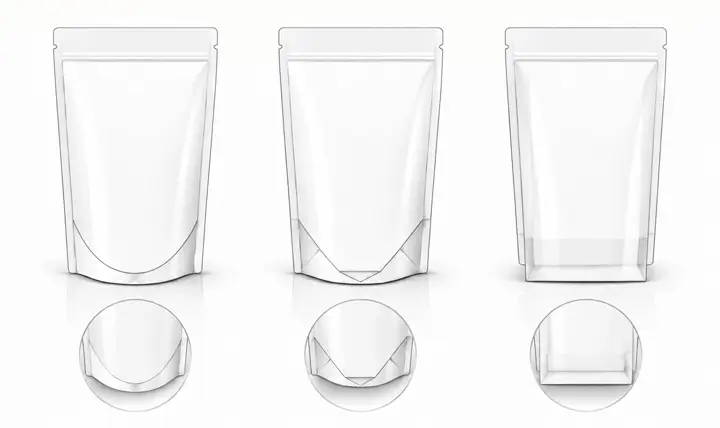
A basic flat pouch is made from two sheets of film heat-sealed together, with a straight seal along the bottom — so once filled, it can only lie flat. A stand-up pouch, by contrast, has a specially engineered bottom: folded gussets and bottom-forming techniques create a flat support structure that also optimizes the space for brand display.
| Style | Bottom Construction | Typical Weight Capacity | Strengths | Limitations |
| Doyen (Doypack) | U-shaped / rounded gusset sealed to panels | Up to ~0.5 kg | Clean look, high printable area, widely available | Often needs format-specific tooling |
| K-Seal | Angled “K” corner seals | 0.5–2.3 kg | Stronger base, flexible formats with same tooling | Slightly different visual profile |
| Flat / Box / Plow Bottom | Squared or folded base with side gussets | Higher (2+ kg) | Premium boxy appearance, excellent stability | Higher material use / cost in some cases |
Why Do Brands Choose Stand-Up Pouches?
Stronger Shelf Appeal
Being able to stand on its own gives a product a larger display area on the shelf. Compared to packaging that lies flat or hangs, a stand-up pouch can carry attractive printed designs on both its front and back panels, putting the brand message, product benefits, and usage instructions right where shoppers can see them.
Better Cost-Effectiveness
Compared to rigid packaging like plastic tubs or glass bottles, stand-up pouches cost 30–50% less in raw materials. There’s no bottle shape taking up space during transport, and the lighter weight further cuts logistics costs. For brands, stand-up pouches are an ideal way to lower costs while boosting efficiency.
Functional Versatility
Stand-up pouches can incorporate a range of functional elements:
- Zipper – allows repeated opening and closing, ideal for products used over multiple occasions
- Spout – suited to liquid products such as juice or sauce
- Notch – makes it easier for consumers to open the pouch
- Euroslot (hang hole) – allows the pouch to be displayed on a hook

Thanks to this structural flexibility, along with diverse printing and functional options, stand-up pouches have become something of a star performer in brand promotion and shelf display.
Materials and Barrier Performance: Choosing the Right Structure Is Key
The performance of a stand-up pouch depends on the film structure it’s built from. Different materials vary in feel, print quality, food compatibility, and recyclability, and most stand-up pouches use a multi-layer composite. Each layer serves its own purpose:
Outer layer – provides the printing surface, heat resistance, mechanical strength, and visual appeal (typically PET, BOPP, or kraft paper)
Barrier layer – provides high-level protection against oxygen, moisture, aroma, and light (EVOH, aluminum foil, metalized PET, SiOx, PA)
Inner/sealant layer – ensures food-contact safety and heat-sealability (PE, CPP, etc.)
Common Structures

PET/PE – A general-purpose structure with good stiffness and printability, suitable for ambient dry goods and snacks; offers moderate barrier protection.
PET/AL/PE (or CPP) – A standard high-barrier structure for products like coffee, tea, milk powder, and seasonings that need strong protection against light, oxygen, and moisture.
PET/VMPET/PE – A metalized structure with moderate barrier performance, costing less than pure aluminum foil — suitable for snacks with moderate freshness needs.
PA/PE – A puncture-resistant structure, suitable for vacuum packaging and bone-in meat products.
Kraft paper + barrier film – Gives a natural, appealing look (note: many paper/plastic combinations are difficult to recycle).
Mono-layer PE (MDO-PE) or Mono PP (BOPP), with EVOH added when needed – Designed specifically for PE or PP recycling streams.
Functional Features and When to Use Them
Depending on the application, a stand-up pouch can be fitted with a range of components. It helps to answer these questions in advance:
- Will the pouch stand upright on the shelf, or hang on display?
- Does the consumer need to reseal it?
- Should the product be visible?
- Is it a liquid or refill product, or one that’s sensitive to aroma, like coffee or tea?
- Are there any special filling or sterilization requirements?
Common Features
- Resealable zipper (press-to-close or slider) – suited to multi-serving products
- Euroslot / hang hole – for hook display
- Clear window – lets consumers see the product (a clear film combined with an opaque white background print can be used if needed; a smoother surface gives better clarity)
- Spout + cap – suited to liquids, sauces, detergents, baby food, and refill packs
- One-way degassing valve – suited to freshly roasted coffee
- Easy-tear notch – makes it easy to open for the first time
- Odor valve or dedicated barrier layer – suited to strong-smelling products
- Metalized film can also create a metallic finish — in some cases giving a look similar to foil stamping, but at a lower cost.
Printing Options
The right choice depends on print run size, quality requirements, and lead time.

Digital Printing (e.g., HP Indigo)
Digital printing offers high quality and full-coverage printing, with low or no plate-making cost. It works well for print runs of 250 to 100,000 units with multiple design variants, and its color output can match traditional gravure printing while simplifying many production steps and material requirements. Once a small batch is approved, production can move smoothly into larger orders. Lead time is typically 10–14 business days.
Flexographic Printing (Flexo)
One of the most widely used printing methods in packaging, flexo uses a flexible relief plate: an anilox roller transfers ink evenly onto the plate surface, which then transfers the image onto the material.
Compared to other traditional printing methods, flexo has certain advantages in material compatibility, continuous production, and the use of eco-friendly inks. It’s cost-effective for very large print runs (100,000+ units), though it requires plates and has a longer lead time.
Inkjet / Memjet Printing
Using digital control, print heads spray ink directly onto the material to form the design, enabling full-color, variable-data printing with no plates required. Turnaround is fast, making this method especially well-suited to personalized, small-batch production with very high efficiency — though it comes with some limitations on material type and print area.
Print file requirements typically include bleed, safe zones, and special treatment for windowed or metallic-finish areas (such as an opaque white ink base). Be sure to check the artwork carefully several times before printing to avoid errors that could affect the final result.
Sustainability: Current Status and Options
Brands around the world are moving quickly to find high-performance packaging that’s sustainable, recyclable, and convenient to use. However, multi-material composite structures are often hard to recycle through standard recycling channels. As regulations continue to advance globally, we believe the following approaches point the way toward a more sustainable future.
Current Solutions
Mono-material (PE/PP) structures – Purpose-built for existing PE and PP recycling systems, these retain good barrier and mechanical performance while enabling genuine closed-loop recycling. They’re currently the most reliable option for making the shift toward sustainability. A mono-material film can be made thinner while still holding onto its barrier performance, stiffness, seal strength, and printability — maximizing sustainability throughout mass production.

Kraft paper look with a barrier lining – Projects a strong sustainability image, though many such products aren’t officially classified as recyclable paper. While it has a naturally eco-friendly appearance, limitations in paper-plastic separation technology mean many such products still can’t be classified directly into paper recycling streams under official standards.
Compostable / bio-based options – These do exist, but usually come with trade-offs in barrier performance, strength, and shelf life. They’re best suited to products with a shorter shelf life or lower protection requirements.
“Design for recycling” principles, along with emerging regulations like Europe’s PPWR, are pushing the industry toward mono-material structures and higher recycled-content ratios.
A genuine shift toward sustainability has to be grounded in transparency and rigor. A “sustainable look” is not the same thing as certified recyclability or a lower carbon footprint across the full life cycle (LCA). We remain committed to using real data and compliant materials to help our clients achieve genuine progress toward greener, lower-carbon packaging.
How to Choose the Right Stand-Up Pouch
- Define Your Product’s Characteristics
Consider its physical form (powder, granules, liquid, paste), weight/volume, density, sensitivity to oxygen, moisture, light, or aroma, target shelf life, filling method (manual or automated), and whether it requires high-temperature sterilization or hot filling.
- Determine Size and Structure
Calculate the volume you need, plus headspace at the top. Test with an actual product sample. Choose the bottom construction based on your fill weight and the look you’re going for.
The pouch’s width, height, and base width together determine its capacity. A wider base gives better stability, but uses more material.
- Choose Materials and Barrier Performance
Match the material to the level of protection you need. Prioritize compliance with food-contact safety standards, and consider mono-material options if recyclability is a goal.
Choose a barrier solution based on how much protection your product actually needs — over-specifying drives up cost unnecessarily, while under-specifying leads to waste. The goal is to strike the right balance between barrier performance and cost.
- Add Functional Design Elements
Do you need a zipper, spout, or easy-tear notch? Each added feature increases the unit cost.
Zippers, clear windows, spouts, degassing valves, hang holes — only add the features that your product and your customers actually need.
- Determine Printing Method and Order Quantity
Choose a manufacturer based on the quantity you need — some factories set minimum order quantities so high that they’re not a good fit, and working with them just wastes time.
Digital printing is a good fit if you want flexibility and a lower minimum order quantity (MOQ); flexo printing is better suited to very large-scale production. You’ll also want to factor in how many SKUs or product variants you need.
- Verify
Request samples and run real filling and sealing tests. Check seal integrity and barrier performance data, and ask your manufacturer for compliance documentation (such as food-contact safety certificates and migration test reports).
About NK Packing
NK Packing is a flexible packaging supplier with over 10 years of industry experience, serving brands, traders, and converters. We offer end-to-end support — from material structure recommendations and custom sizing to printing and final delivery — and specialize in recommending the right stand-up pouch structure for your product, including high-barrier, zipper, spout, window, and recyclable mono-material options.
- Strict quality control and a stable supply chain ensure consistent appearance, dimensions, and barrier performance
- Flexible minimum order quantities and support for multiple product variants reduce the risk of small- and medium-batch trial production
- Extensive international export experience, with a solid understanding of global food-contact compliance and delivery requirements
- Our engineers can help optimize material structures to control costs while still meeting the protection performance you need
If you’ve already settled on your product type and general requirements, just share the details — weight, form, target shelf life, whether you need a zipper or spout, and so on — and we’ll provide specific structural recommendations and sample support to help you move faster from selection to full-scale production.
Frequently Asked Questions
What are the main types of stand-up pouch packaging?
The primary classification is based on bottom construction (Doyen, K-Seal, flat bottom), followed by functional features (zipper, spout, window, valve) and material structure.
Are there recyclable types of stand-up pouches?
Yes — mono-PE and mono-PP stand-up pouches are specifically designed for recyclability within existing plastic recycling streams.
What’s the difference between Doyen and K-Seal stand-up pouches?
Doyen pouches have a rounded bottom and are ideal for lighter products. K-Seal pouches have angled seals, stronger base performance, and more flexible sizing options.
Are stand-up pouches recyclable?
Traditional multi-material versions often aren’t accepted in standard recycling streams, but mono-PE or mono-PP designs are engineered for better recyclability — it’s worth checking with local recycling systems and your supplier’s data to confirm.
Can stand-up pouches be used for liquids?
Yes, as long as they’re fitted with the right spout, sufficient seal strength, and an appropriate barrier film.
How can I get the best shelf life for my product?
The key is combining the right barrier structure with strong seals, suitable features (like a degassing valve for coffee), and proper storage conditions.


